
Stacks another {2} generic Sphinx cost reduction and adds card selection to every Sphinx that enters.
Pre-Release Research
The Ur-Sphinx Commander: 10 Sphinx & Support Cards to Watch
The Ur-Sphinx rewards expensive Sphinxes cast ahead of curve and wide Sphinx attacks. Unesh, Urza's Incubator, and Maskwood Nexus lead early synergy, while Unesh's own market is a severe U.S. supply shock that Europe has not confirmed.
- Published
- Sep 17, 2026
- Updated
- Sep 17, 2026
- Market checkpoint
- Research snapshot: Sep 18, 2026
- Scope
- Commander research
Quick Answer
What matters most right now
The Ur-Sphinx rewards two things more than anything else: casting expensive Sphinxes ahead of curve, and attacking with enough Sphinxes to turn its mill-and-free-cast trigger into a real engine. The market story is less settled -- Unesh has already seen a severe U.S. supply shock while Europe still shows deep, inexpensive supply, so exact-market and exact-print verification matters more than usual.
Pushes the deck's naturally high curve down another {2} generic mana on top of Eminence.
The most interesting build-around: turns every creature spell into a Sphinx spell for Eminence and every creature into a Sphinx for the attack trigger.
Strategy
How The Ur-Sphinx changes Sphinx decks
- Generic mana symbols matter. A Sphinx with two or more generic mana in its cost benefits far more than a cheap Sphinx with only colored pips.
- Cost reducers stack. Urza's Incubator, Unesh, Herald's Horn, Warden of Evos Isle, and similar effects can turn a traditionally clunky Sphinx curve into a much faster one.
- Attack quantity matters, not target. The Ur-Sphinx does not care which Sphinxes attack or whether they hit a player -- simply declaring more Sphinx attackers increases the mill sample for every player.
- The commander can stay in the command zone. Eminence works from the command zone, so support cards that improve the Sphinx creature suite matter more than cards that only protect a nine-mana commander on the battlefield.
- Type-changing effects can rewrite the deck. A non-Sphinx creature spell that becomes a Sphinx spell gets the Eminence discount; a non-Sphinx creature on the battlefield that becomes a Sphinx adds to the attack-trigger count.
- The free-cast trigger is strongest in multiplayer. Each opponent and the Ur-Sphinx player can contribute a different milled card to cast, so more cards milled per player improves selection rather than just filling one graveyard.
Early-Data Warning
Early-data warning
The Ur-Sphinx's EDHREC page expanded extremely quickly during this research window: a cached crawl showed 296 decks, while the live page opened during research showed 794 decks. Every inclusion percentage below is provisional.
The Ur-Sphinx is part of the Multiverse Reforged Commander product releasing with Reality Fracture on October 2, 2026. Pre-release databases can currently mark it as not yet legal because the card has not released, and this page should be updated after release rather than treated as a solved ranking.
Top 10
10 Sphinx & support cards to watch
Ranked on gameplay synergy, deckbuilding usefulness, early adoption, market relevance, supply/reprint profile, and editorial usefulness -- not by price spike or EDHREC percentage alone. This is a watchlist, not a buy list.
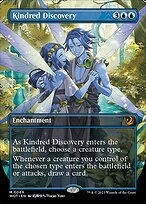
#10Sphinx PayoffBenchmark printMSC #150 External benchmark~$6.30 (Sep 11) 7-day / 30-day move+0.2% / +16.0% Tracked printings11 across 7 sets
Kindred Discovery
Choose Sphinx as Kindred Discovery enters. It draws a card whenever a Sphinx you control enters or attacks -- the attack half overlaps directly with The Ur-Sphinx's payoff, so the same declaration that grows the mill/free-cast sample also refills your hand. It is an enchantment, so Eminence does not reduce its cost.
Market read: Broad adoption, ample supply. This is already a known typal staple with substantial reprint depth, so Ur-Sphinx demand would need to be broad to tighten ordinary copies.
What to watch next: Watch whether several ordinary nonfoil printings lose inventory together after release -- one premium treatment moving is not enough.

#9Attack/Trigger SupportNeoPrice (LCI #258)$59.12 Pricing ConfidenceHigh Tracked inventory90 External benchmark~$48.52 nonfoil (Sep 10), +5.4% / +11.6%
Roaming Throne
Choose Sphinx as Roaming Throne enters and it becomes a Sphinx on the battlefield, counting toward the attack total. While The Ur-Sphinx is actually on the battlefield, Roaming Throne makes its attack trigger happen an extra time, and it also doubles other Sphinxes' triggered abilities (including Unesh's card-selection trigger). It does not double Eminence, which is static, and Roaming Throne itself is a Golem spell so it does not receive the Eminence discount.
Market read: Broad adoption, expensive but not Ur-Sphinx-specific. Roaming Throne already has enormous Commander demand across many decks, so a price move here cannot be attributed to one new commander without stronger evidence.
What to watch next: Compare ordinary LCI inventory against premium and Secret Lair versions -- do not read one aggregate price.
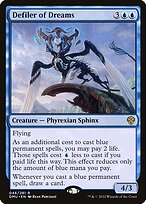
#8Sphinx PayoffExternal benchmark~$0.40 nonfoil (Sep 7) 7-day / 30-day moveflat / -14.9% Tracked printings4, multiple treatments
Defiler of Dreams
Defiler of Dreams is itself a Sphinx, so The Ur-Sphinx reduces its generic cost. It then helps a blue-heavy Sphinx deck cast additional blue permanent spells more efficiently and rewards those casts with card draw -- a solid mid-curve engine for a deck full of six- and seven-mana flyers.
Market read: Broad adoption, ample supply. Gameplay adoption is already strong, but there is no meaningful price signal yet.
What to watch next: Watch seller count and ordinary-print inventory rather than price -- if adoption stays above ~70% as the EDHREC sample matures and supply starts declining, the signal gets stronger.
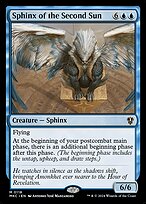
#7Sphinx PayoffExternal benchmark~$3.50 nonfoil (Sep 10) 7-day / 30-day move+161.2% / +173.4% Tracked printings5 across 4 sets, 8 reprint entries
Sphinx of the Second Sun
The Ur-Sphinx reduces its generic cost, helping an eight-mana Sphinx arrive earlier. After your postcombat main phase it gives you another beginning phase -- untap, upkeep, and draw. That is not an additional combat by itself; the value is attacking with a board of expensive Sphinxes, then untapping them and refreshing mana/cards before passing the turn.
Market read: Market movement exists, but causation is unproven. The large move was already visible in data dated Sep 10 -- before The Ur-Sphinx's Sep 16 reveal -- so it would be incorrect to attribute that spike to The Ur-Sphinx.
What to watch next: Look for a second leg after Sep 16 across multiple ordinary printings; that would be far more informative than the pre-existing move.
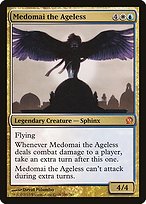
#6Attack/Trigger SupportExternal benchmark (THS #196)~$3.72 nonfoil (Sep 7) 7-day / 30-day move-13.7% / -25.9% Tracked printings1 paper printing plus foil treatment
Medomai the Ageless
The Ur-Sphinx reduces Medomai from six mana to five. When it deals combat damage to a player, you take an extra turn -- Medomai itself cannot attack again that turn, but your other Sphinxes can, giving another shot at The Ur-Sphinx's attack trigger. This is one of the cleanest ways in Esper to convert successful combat into another trigger cycle.
Market read: Organic demand forming, not yet reflected in price. Adoption is high while price had been declining before the reveal -- one of the more interesting watch cards.
What to watch next: Check current THS #196 seller count and NM inventory now, then again at prerelease and release. A rapid seller-count decline with stable completed-sale prices would be an early supply signal.
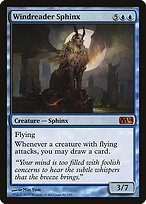
#5Sphinx PayoffJumpstart #194~$0.29 M14 #81~$0.35-$0.37 Foundations Jumpstart #391~$0.31-$0.33 Core 2019 #84~$0.30-$0.32
Windreader Sphinx
Windreader Sphinx gets the Eminence discount and rewards exactly what The Ur-Sphinx wants: attacking with flying creatures. It draws one card per attacking flyer, and most of the Sphinx package naturally has flying, so one wide attack can generate Windreader draws and grow The Ur-Sphinx's mill/free-cast selection at the same time.
Market read: Broad adoption, ample supply. It is one of the best gameplay fits, but reprint depth makes a sudden sustainable market move less likely.
What to watch next: If demand is real, cheaper ordinary printings should move together -- a single M14 mythic treatment moving would not establish broad scarcity.
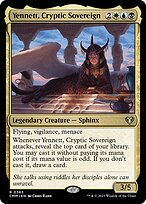
#4Core SphinxNeoPrice (C18 #51 foil)$0.66 Pricing ConfidenceModerate Tracked copies / sellers233 / 71 7-day moveroughly flat CMM #363 regular reference~$0.43, large baseline supply
Yennett, Cryptic Sovereign
The Ur-Sphinx reduces Yennett from {2}{W}{U}{B} to {1}{W}{U}{B}. Flying, vigilance, and menace make it a particularly safe attacker for growing the Sphinx attack count, and its own attack trigger can cast an odd-mana-value card from the top of your library for free (or draw it if you cannot) -- a second, independent free-cast engine.
Market read: Broad adoption, ample supply. This is a core deck card, but current supply is deep enough that high inclusion has not translated into scarcity.
What to watch next: Watch ordinary Commander Masters copies for sales velocity rather than the old C18 foil alone.
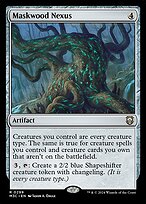
#3Typal SupportM3C #299$2.79, High Confidence, 304 tracked inventory DRC #132$1.58, High Confidence, 289 tracked inventory BLC #279$2.23, High Confidence, 158 tracked inventory KHM #240$3.05, Moderate Confidence, 74 tracked inventory External benchmark~$1.61 cheapest playable nonfoil (Sep 10), many reprints
Maskwood Nexus
The most strategically transformative support card in this research. It makes creatures you control, creature spells you control, and creature cards you own outside the battlefield every creature type -- so with The Ur-Sphinx in the command zone, every creature spell you cast becomes a Sphinx spell for Eminence, and on the battlefield every creature can count as a Sphinx for the attack trigger. It also makes 2/2 changeling tokens, which are automatically Sphinxes.
Market read: Early attention only; supply is ample. The gameplay interaction is much stronger than the current market case.
What to watch next: The first signal should be EDHREC inclusion growth, not price. If Nexus moves from ~5% into the teens while ordinary inventory falls across several printings, revisit the market thesis.
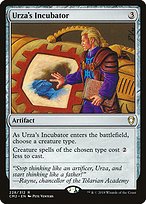
#2Typal SupportNeoPrice (MH3 #297)$23.30 Pricing ConfidenceHigh Tracked copies / sellers154 / 67 7-day move / inventory trendroughly flat / +9.2% Tracked printings9 Liquidity / sensitivityDeep / Low
Urza's Incubator
Choose Sphinx: Urza's Incubator makes those creature spells cost {2} less, while Eminence makes them cost another {1} less. Together a Sphinx spell can get {3} generic cost reduction before any other reducer is added -- important for a tribe whose best creatures commonly cost five to eight mana.
Market read: Broad adoption, ample supply. One of the strongest gameplay support cards, but current NeoCardAlpha data does not show a Ur-Sphinx-driven squeeze.
What to watch next: Do not chase the headline card -- watch whether the deep MH3 supply begins declining after October 2 while EDHREC inclusion stays above 60%.
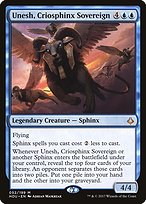
#1Core Sphinx / Market WatchNeoPrice (HOU #52)$11.07 7-day move+1233.7% Pricing ConfidenceOutlier Risk Tracked copies / sellers4 / 2 7-day inventory trend-98.5% Market sensitivityExtreme Marketplace agreementDisagreement
Unesh, Criosphinx Sovereign
Unesh is the cleanest mechanical partner for The Ur-Sphinx. The Ur-Sphinx reduces Unesh from six mana to five, and once on the battlefield Unesh gives your Sphinx spells another {2} generic cost reduction -- with both Eminence and Unesh active, other Sphinx spells cost {3} less before any Incubator/Herald effects. Unesh also turns every Sphinx entering under your control into a four-card pile-selection trigger, so the same creatures you want for the attack engine refill your hand as they enter.
Market read: Real attention plus a severe U.S. thin-supply spike plus unstable cross-market pricing. An outside TCGplayer-focused report said near-mint copies averaged about $1.22 before the reveal, followed by more than 220 near-mint sales and asking prices near $19.95 after cheap U.S. supply was cleared -- but a recent Cardmarket crawl still showed 1,306 available items, offers beginning around €0.15-€0.40, and a price trend near €0.81. There is clearly new demand, but the evidence does not support treating a $20 asking price as a globally established market value. NeoCardAlpha's Outlier Risk label is appropriate.
What to watch next: Track completed U.S. sales at $10+ rather than asking prices, U.S. seller/listing replenishment, English-language Cardmarket supply specifically, whether the HOU regular and promo foil converge or diverge, and EDHREC adoption after the first post-release month.
Early Deckbuilders
What early deckbuilders are actually using
Unesh, Criosphinx Sovereign -> Yennett, Cryptic Sovereign -> Magister Sphinx -> Tivit, Seller of Secrets -> Medomai the Ageless -> Raffine, Scheming Seer -> Defiler of Dreams -> Windreader Sphinx -> Consecrated Sphinx -> Sphinx of the Second Sun
That should not be mistaken for a solved list -- the data is growing too quickly, and high inclusion does not always equal high Ur-Sphinx-specific synergy.
Strong cards that missed the Top 10
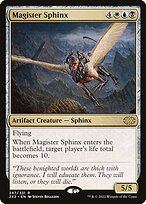 79% / 630 decks
Magister Sphinx
Very good finisher and receives Eminence reduction, but its main payoff is an ETB life-total reset rather than a multiplicative Ur-Sphinx engine.
Check next: Whether it keeps pace with the core Sphinx package after release.
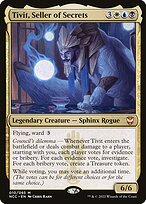 76% / 607 decks
Tivit, Seller of Secrets
Excellent standalone Commander card and a Sphinx body, but most of its power comes from its own voting/Treasure/Clue engine, not the Ur-Sphinx interaction.
Check next: Whether it's being played for The Ur-Sphinx specifically or just as a generic Esper staple.
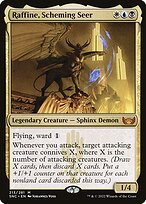 75% / 597 decks
Raffine, Scheming Seer
Excellent cheap flying attacker, but its {W}{U}{B} mana cost has no generic mana, so Eminence does not discount it.
Check next: Whether adoption holds even without the cost-reduction synergy.
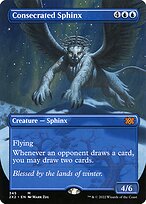 68% / 543 decks
Consecrated Sphinx
Raw power is unquestioned, but it is a generic draw engine, and NeoCardAlpha tracks roughly ten printings, reducing the market-scarcity angle.
Check next: Ordinary-print inventory across its many printings after release.
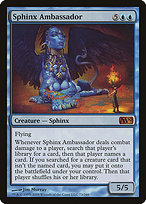 52% / 413 decks
Sphinx Ambassador
Entertaining gameplay, but the current market is a more important story than its ranking -- a shallow old-printing profile is already showing buyout behavior.
Check next: See the watchlist below rather than ranking it on price alone.
 63% / 497 decks
Sphinx of False Conclusions
A promising new Reality Fracture Sphinx, but it is unreleased and lacks mature market/deck evidence.
Check next: Revisit once the card has release-week deck and market data.
Unesh Market Investigation
The Unesh price spike: real demand or thin supply?
U.S. reading: An outside TCGplayer-focused report said near-mint copies averaged about $1.22 before the reveal, followed by more than 220 near-mint sales and asking prices near $19.95 once cheap U.S. supply was cleared. NeoCardAlpha's own representative feed shows only 4 tracked copies from 2 sellers -- an Outlier Risk market by definition.
Europe reading: A recent Cardmarket crawl still showed 1,306 available items, with offers beginning around €0.15-€0.40 and a price trend near €0.81. Europe has not confirmed the U.S. valuation.
Unesh has genuine Ur-Sphinx demand, but the current U.S. price is being discovered in an extremely thin market. Cross-market supply has not confirmed a universal $20 valuation.
What to watch next:
- Completed U.S. sales at $10+ rather than asking prices.
- U.S. seller/listing replenishment.
- English-language Cardmarket supply specifically.
- Whether the HOU regular and promo foil converge or diverge.
- EDHREC adoption after the first post-release month.
Toolbox Build
Sphinx's Approach and the new toolbox angle
Sphinx's Approach is a new Reality Fracture common: "Draw two cards. Then you may exile this spell and four cards named Sphinx's Approach from your graveyard. If you do, search your library for a Sphinx creature card, put it onto the battlefield, then shuffle. A deck can have any number of cards named Sphinx's Approach."
That makes it more than another one-of support spell -- it can change the composition of an Ur-Sphinx deck entirely. Current evidence: 10% EDHREC inclusion (76 of 735 eligible decks); one public Archidekt builder says the list will use at least 10 copies, and another public list is already testing 22. There is no settled "correct number" yet -- early builders treat roughly 10-20+ as plausible depending on whether the deck is Sphinx typal first or Approach-combo first.

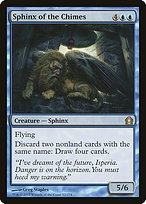
Sphinx of the Chimes interaction
Sphinx of the Chimes: "Discard two nonland cards with the same name: Draw four cards." That text is normally awkward in Commander singleton, but Sphinx's Approach breaks the singleton restriction for itself, so Chimes can discard pairs of Approaches, draw four, and rapidly place Approaches in the graveyard needed to turn a later Approach into a Sphinx tutor. This interaction is rules-valid and already receiving creator/community attention.
Market caution
Sphinx of the Chimes was historically a bulk rare with very deep supply. A recent TCGplayer crawl showed a market price around $0.26 and more than 1,100 listings. Community-reported retailer scraping on Sep 17 claimed a sudden burst of hundreds of sales after Sphinx's Approach was revealed, but that is an attention signal, not independently verified sustainable market demand.
The better question is not "did Chimes spike?" It is: can new Approach demand actually consume a historically enormous bulk supply pool?
Three emerging builds
Watchlist
3 cards NeoCardAlpha should monitor
This is a watchlist, not a recommendation to buy.
Watchlist
Medomai the Ageless
76% early Ur-Sphinx inclusion and a highly relevant extra-turn combat structure, on a shallow paper-printing profile -- yet the latest pre-reveal benchmark was about $3.72 and had been falling.
Confirms if: Seller count and NM inventory fall materially after Sep 16 while completed sales remain healthy.
Invalidates if: EDHREC inclusion falls, or inventory stays stable through release despite hundreds/thousands of Ur-Sphinx decks.
Watchlist
Sphinx Ambassador
52% early inclusion and a 2009-only main printing make it extremely sensitive to even modest demand. Current data already shows signs of a speculative clear-out.
Confirms if: Completed sales repeatedly occur at the new higher prices and non-U.S. marketplaces also lose inventory.
Invalidates if: Listings refill rapidly while actual sale prices remain far below the new asks.
Watchlist
Sphinx of the Chimes
Sphinx's Approach gives an old, previously awkward Commander ability a real structural purpose. The card was historically cheap and deep, making it an excellent demand-vs-supply experiment.
Confirms if: Retailer and marketplace inventory keeps declining for several days after the Approach reveal, with actual sale prices rising across more than one marketplace.
Invalidates if: The historically deep supply absorbs the initial speculative buying and ordinary copies remain near bulk pricing.
Invalidation
What could invalidate this thesis?
- The EDHREC sample changes substantially after release.
- The Ur-Sphinx becomes a short-lived preview-season novelty rather than a durable Commander.
- Reprints arrive quickly for one-printing Sphinxes.
- Sphinx's Approach builds converge on fewer Sphinx creatures and make traditional typal rankings less relevant.
- Speculative U.S. buyouts restock before real players begin buying decks.
- Europe and the U.S. remain too disconnected for a single headline price to be meaningful.
- The best builds move toward changelings/non-Sphinx creatures via Maskwood Nexus, reducing demand for mediocre legacy Sphinxes.
- The commander is powerful from the command zone but too expensive to cast often enough for Roaming Throne and other battlefield-trigger amplifiers to justify their slots.
Methodology
Sources, limits, and what to check next
Methodology
Multiverse Reforged Commander product and release information.
Current The Ur-Sphinx deck sample; treated as provisional and rapidly changing.
Early deck-construction experiments, including Sphinx's Approach copy counts.
Interaction verification for Eminence, type-changing effects, and Sphinx's Approach.
Cards are not ranked by price spike or EDHREC percentage alone; raw scores are intentionally omitted.
Source boundaries
NeoPrice, Pricing Confidence, inventory, seller depth, and version distinctions when available.
Used when NeoCardAlpha exact-print data was unavailable.
Used alongside NeoCardAlpha for supply signals.
Never averaged into NeoPrice.
Used for European supply comparison and other market references.
Never treated as proof of sustainable demand.
Primary sources
Wizards of the Coast -- Multiverse Reforged Commander decklistEDHREC -- The Ur-SphinxNeoCardAlpha -- Unesh, Criosphinx SovereignNeoCardAlpha -- Yennett, Cryptic SovereignNeoCardAlpha -- Urza's IncubatorCardmarket -- Unesh, Criosphinx SovereignSphinx's Approach card textTCG Strat card-market referencesPublic early deck -- The Ur-Sphinx (Archidekt)Public early deck -- Riddles Already Solved (Archidekt)