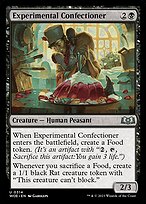
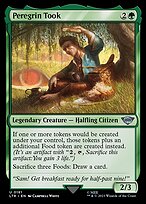
Peregrin Took and Experimental Confectioner are on the battlefield.
At least three Foods are available to begin.
Sequence
Activate Peregrin Took by sacrificing three Foods.
Experimental Confectioner triggers three times and creates three Rats.
Peregrin Took adds one Food to each token-creation event.
Resolve Peregrin's ability, draw a card, and repeat while cards remain.
Interruption Points
Remove either permanent, stop token creation, or stop the Food sacrifice before the resources are restored.
Rules notes: Verified Oracle identity: Canonical card data identifies Frodo as a {W}{B} 1/3 legendary Halfling Scout with partner with Sam, vigilance, and the conditional attack trigger. The page reads Oracle text from canonical card data. Official attack ruling: Frodo's ability does not trigger unless at least 3 life was gained before he attacks. Life lost during the turn does not reduce the amount the ability sees, and gaining more than 3 life still tempts only once. Ring progression: The Ring temptation happens first. The following draw check uses the resulting Ring-bearer and temptation state, so the second temptation can satisfy the two-or-more threshold when Frodo is the Ring-bearer. Official partner construction: Frodo and Sam may be paired as commanders for an Abzan deck with a 98-card library. Frodo alone is Orzhov with a 99-card library. The two commanders retain separate tax and commander-damage tracking. Sam and Frodo combat timing: Rules inference: Sam's beginning-of-combat trigger resolves before declare attackers. The active player then receives priority, may activate the new Food for {1} while Sam remains present, gain 3 life, and subsequently declare Frodo as an attacker. Triggered ability independence: Once Frodo's attack trigger is on the stack, removing Frodo does not remove that trigger. The Ring can still tempt its controller; the later draw requires Frodo to be that player's Ring-bearer when checked.
Last reviewed: Aug 22, 2026
Infinite
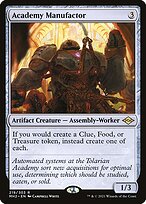
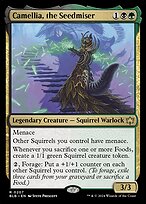
Sam + Peregrin Took + Camellia + Academy Manufactor
Verified
Infinite artifact, Food, Clue, and creature tokens; card draw, lifegain, and associated ETB/LTB/sacrifice triggers.
The Frodo/Sam Abzan configuration supplies the required black and green identity.
One generic mana to begin; the Treasure restores it each loop.
Sequence
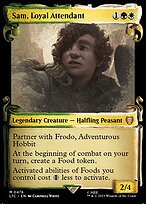
Activate a Food for {1} because Sam reduces its activation cost.
Camellia creates a Squirrel; Peregrin Took and Academy Manufactor create the Food, Clue, and Treasure resources.
Resolve the Food for 3 life, sacrifice the Treasure for {1}, and repeat.
Interruption Points
Remove Sam or a replacement/trigger piece before the resource loop closes.
Rules notes: Verified Oracle identity: Canonical card data identifies Frodo as a {W}{B} 1/3 legendary Halfling Scout with partner with Sam, vigilance, and the conditional attack trigger. The page reads Oracle text from canonical card data. Official attack ruling: Frodo's ability does not trigger unless at least 3 life was gained before he attacks. Life lost during the turn does not reduce the amount the ability sees, and gaining more than 3 life still tempts only once. Ring progression: The Ring temptation happens first. The following draw check uses the resulting Ring-bearer and temptation state, so the second temptation can satisfy the two-or-more threshold when Frodo is the Ring-bearer. Official partner construction: Frodo and Sam may be paired as commanders for an Abzan deck with a 98-card library. Frodo alone is Orzhov with a 99-card library. The two commanders retain separate tax and commander-damage tracking. Sam and Frodo combat timing: Rules inference: Sam's beginning-of-combat trigger resolves before declare attackers. The active player then receives priority, may activate the new Food for {1} while Sam remains present, gain 3 life, and subsequently declare Frodo as an attacker. Triggered ability independence: Once Frodo's attack trigger is on the stack, removing Frodo does not remove that trigger. The Ring can still tempt its controller; the later draw requires Frodo to be that player's Ring-bearer when checked.
Last reviewed: Aug 22, 2026
Infinite
Sam + Warren Soultrader + Academy Manufactor + Experimental Confectioner
Verified
Infinite artifact and Clue tokens; creature ETB/LTB, death and sacrifice triggers; lifegain and lifegain triggers.
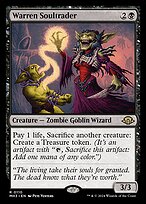
Pay 1 life and sacrifice another creature to Warren Soultrader, creating Food, Clue, and Treasure through Academy Manufactor.
Sacrifice the Treasure for {1}, then activate and sacrifice the Food for {1} because of Sam.
Experimental Confectioner creates a Rat; resolve the Food for 3 life and repeat.
Interruption Points
Remove any engine piece before Rat, mana, Food, or life is restored.
Rules notes: Verified Oracle identity: Canonical card data identifies Frodo as a {W}{B} 1/3 legendary Halfling Scout with partner with Sam, vigilance, and the conditional attack trigger. The page reads Oracle text from canonical card data. Official attack ruling: Frodo's ability does not trigger unless at least 3 life was gained before he attacks. Life lost during the turn does not reduce the amount the ability sees, and gaining more than 3 life still tempts only once. Ring progression: The Ring temptation happens first. The following draw check uses the resulting Ring-bearer and temptation state, so the second temptation can satisfy the two-or-more threshold when Frodo is the Ring-bearer. Official partner construction: Frodo and Sam may be paired as commanders for an Abzan deck with a 98-card library. Frodo alone is Orzhov with a 99-card library. The two commanders retain separate tax and commander-damage tracking. Sam and Frodo combat timing: Rules inference: Sam's beginning-of-combat trigger resolves before declare attackers. The active player then receives priority, may activate the new Food for {1} while Sam remains present, gain 3 life, and subsequently declare Frodo as an attacker. Triggered ability independence: Once Frodo's attack trigger is on the stack, removing Frodo does not remove that trigger. The Ring can still tempt its controller; the later draw requires Frodo to be that player's Ring-bearer when checked.
All three permanents are available in the documented zones.
A Food is available to begin.
Sequence
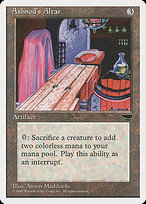
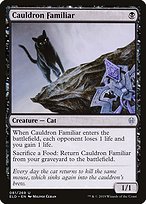
Sacrifice Cauldron Familiar to Ashnod's Altar for {C}{C}.
Sacrifice a Food to return Cauldron Familiar from the graveyard.
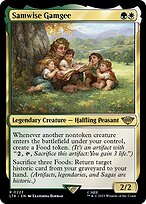
Resolve Familiar's drain and Samwise Gamgee's trigger to restore the Food, then repeat.
Interruption Points
Graveyard hate, removal, or stopping the Food replacement breaks the loop.
Rules notes: Verified Oracle identity: Canonical card data identifies Frodo as a {W}{B} 1/3 legendary Halfling Scout with partner with Sam, vigilance, and the conditional attack trigger. The page reads Oracle text from canonical card data. Official attack ruling: Frodo's ability does not trigger unless at least 3 life was gained before he attacks. Life lost during the turn does not reduce the amount the ability sees, and gaining more than 3 life still tempts only once. Ring progression: The Ring temptation happens first. The following draw check uses the resulting Ring-bearer and temptation state, so the second temptation can satisfy the two-or-more threshold when Frodo is the Ring-bearer. Official partner construction: Frodo and Sam may be paired as commanders for an Abzan deck with a 98-card library. Frodo alone is Orzhov with a 99-card library. The two commanders retain separate tax and commander-damage tracking. Sam and Frodo combat timing: Rules inference: Sam's beginning-of-combat trigger resolves before declare attackers. The active player then receives priority, may activate the new Food for {1} while Sam remains present, gain 3 life, and subsequently declare Frodo as an attacker. Triggered ability independence: Once Frodo's attack trigger is on the stack, removing Frodo does not remove that trigger. The Ring can still tempt its controller; the later draw requires Frodo to be that player's Ring-bearer when checked.
Last reviewed: Aug 22, 2026
Card Intelligence
Exact cards to compare
Open card pages for exact printing, NeoPrice, Pricing Confidence, CardTrader inventory, seller depth, and version checks.
A verified combo explains a gameplay relationship. It does not prove that the combo is causing current price or inventory movement. Compare exact printing, condition, finish, seller depth, marketplace agreement, and Pricing Confidence separately.